Most emergency preparedness advice focuses on supplies: water, food, a flashlight, a first aid kit. That’s important, and if you’ve already worked through our 72-hour emergency kit checklist, you’ve covered the physical side well.
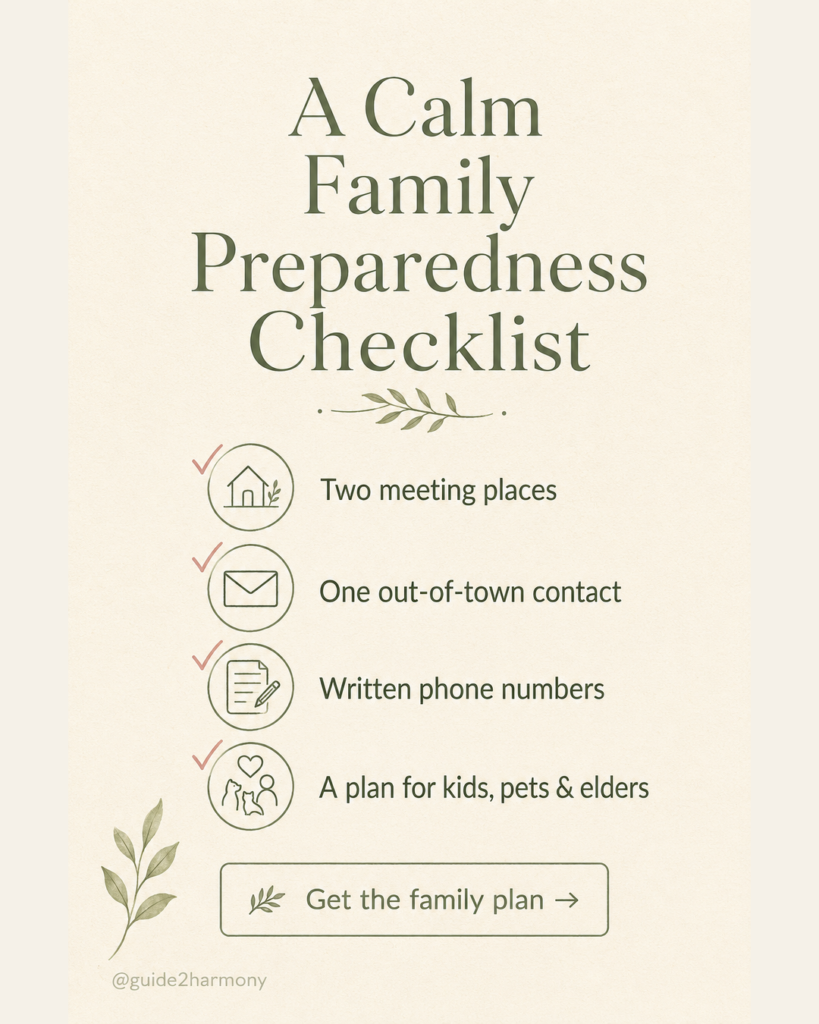
But a full kit doesn’t answer a much more basic question: if something happened right now, would everyone in your household know what to do — and know how to find each other? That’s the piece most checklists skip, and it’s genuinely simple to put in place. No drills, no worst-case scenario planning, no fear-based language. Just four practical decisions, made once, calmly, before you need them.
1. Two Meeting Places
If your household gets separated during an emergency — a fire, a sudden evacuation, anyone away from home when something happens — you need somewhere to reunite that doesn’t depend on phones working.
Pick two:
- A spot right outside your home. A specific neighbor’s doorstep, a mailbox, a tree at the
end of the street — somewhere close enough to reach on foot in a hurry, useful for something like a house fire where you can’t go back inside.
- A spot outside your immediate neighborhood. A relative’s home, a library, a community
center — somewhere to go if you can’t get back to your street at all.
The second spot matters more than it seems. It’s the one that covers the scenario where “just go home” isn’t an option.
Practical tip: say both locations out loud with everyone in the household, including kids old enough to understand. A meeting place only works if everyone actually knows it — writing it down (see step 3) is a backup, not a substitute for everyone hearing it directly.
2. One Out-of-Town Contact
During a local emergency, calling or texting someone across town can be harder than reaching someone further away — local phone networks get overloaded first. A single out-of-town contact, agreed on in advance, gives everyone in the household one number to call (or text, which often gets through even when calls don’t) to check in and relay messages.
This works especially well for larger households or families with kids at school, a partner at work, and grandparents nearby — everyone can reach one person even if they can’t reach each other directly.
Practical tip: ask the person directly and confirm they’re willing to be that contact — don’t assume. Make sure every household member, including babysitters or regular caregivers, has that number.
3. Written Phone Numbers
Most of us don’t actually know phone numbers anymore — they’re saved in a phone that might be lost, dead, or unreachable exactly when you need them most. A small card with the essentials, written by hand or printed, closes that gap for free:
- Each family member’s number
- The out-of-town contact’s number
- Both meeting place addresses
- Any essential numbers that aren’t intuitive to recall (a doctor, a pharmacy, a pet’s vet)
Practical tip: make one card per household member and keep a copy in a wallet, backpack, or the emergency kit itself — not just saved as a photo on a phone that might not be available. Laminating it or slipping it into a zip-top bag keeps it readable even if it gets wet.
4. A Plan for Kids, Pets, and Elderly Family Members
The people and animals in your household who can’t fully plan for themselves need a specific, simple answer to “who handles this if I can’t.” Three questions cover most of it:
- Who picks up the kids if you can’t get to school or daycare yourself? Confirm this with
that person directly, and make sure the school has them listed as an authorized pickup.
- Who checks on elderly or less mobile family members nearby, and do they have a way to
reach that person that doesn’t depend on a phone call going through?
- What’s the plan for pets — a carrier that’s easy to grab, a few days of food set aside, and
someone who could care for them if you’re delayed getting home?
None of this needs to be elaborate. The goal is simply that everyone involved — including the people doing the picking-up and checking-in — actually knows the plan, rather than assuming someone else has it handled.
Why This Part Gets Skipped
It’s easy to see why the family plan gets left out of most checklists — a flashlight and a case of water are things you can buy in an afternoon and check off a list. Deciding who calls whom, where everyone meets, and who picks up the kids requires an actual conversation with the other people in your household, sometimes more than one. That’s a different kind of effort than shopping, and it’s the part that’s easy to keep postponing.
The reassuring part is that it’s also the cheaper half of preparedness. None of the four steps above cost anything beyond the time to have the conversation and write a few things down. If you’ve already built a physical kit, this is the piece that makes it actually useful — a kit sitting in a closet doesn’t help much if nobody knows where to meet or who’s responsible for what.
Putting It Together
None of these four steps cost anything, and together they take less time than building the physical kit did. What they add is the part a kit alone can’t provide: everyone in your household knowing where to go, who to call, and who’s responsible for whom — calmly decided in advance, not figured out under pressure.
Practical tip: review the whole plan every six months. Meeting places stay relevant, but phone numbers change, kids get old enough to remember more themselves, and pickup arrangements shift as schools or routines change. A quick recheck twice a year — spring and autumn work well — keeps it accurate without turning into a chore.
If you’d like this plan alongside a full staged supply checklist in one place, the free 72-Hour Family Guide walks through both the kit and this kind of family planning step by step, so you’re not managing two separate systems.
FAQ
Do we need to write all of this down, or is talking about it enough? Talking it through matters most — that’s how everyone actually learns the plan. Writing it down (the phone number card especially) is a backup for the moment memory alone isn’t reliable, not a replacement for the conversation.
What if our out-of-town contact is unreachable too? No single point of contact is guaranteed to work every time, which is exactly why it’s paired with the two meeting places — if the contact plan fails, the physical meeting points still stand on their own.
Our kids are very young — is this plan still useful? Yes, adjusted to their age. Very young children may not manage a phone card, but they can still learn a meeting place as a simple, calm routine (“if we ever get separated, we go to…”), and the adult-facing parts of the plan (pickup arrangements, contact numbers) matter just as much regardless of the kids’ age.
How is this different from the 72-hour kit checklist? The kit checklist covers supplies — what you’d physically need for three days. This plan covers people — where you meet, who you call, and who looks after whom. They’re meant to work together, not replace each other.
Do we need to do this all in one sitting? No. All four steps can happen over a week or two, one conversation at a time. The only real requirement is that everyone involved eventually knows all four pieces, not that it happens instantly.
Keep Building
Once your checklist is in place, two natural next steps: How to Talk to Your Family About Preparedness (Without Panic) to actually walk everyone through the plan, and Emergency Preparedness for Families in Europe for the regional context behind some of these choices.